https://theworldfinancialforum.com/participate/
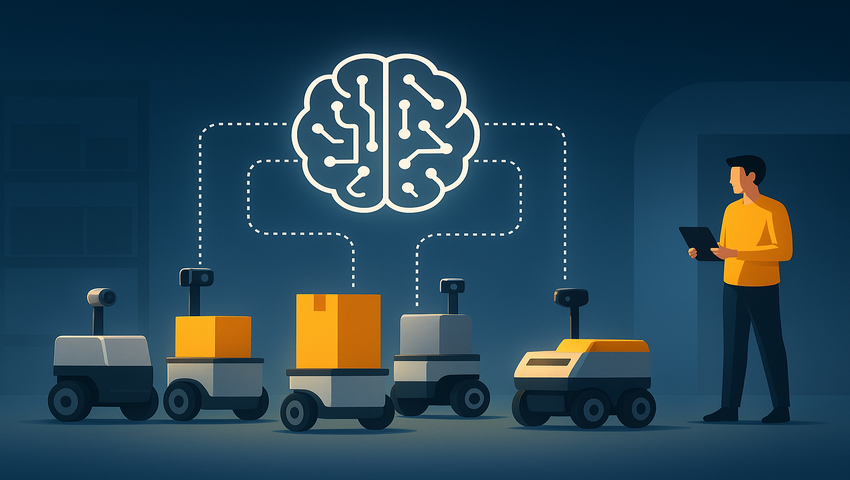
Machine mind A team of engineers has developed a multi-robot system that enables machines to operate with a “collective brain,” coordinating tasks, navigating complex environments, and avoiding obstacles autonomously. Unlike conventional robots that work in isolation, this system allows robots to function as a cohesive unit, executing complex operations more efficiently and safely.
The concept of a collective brain allows robots to share information about their environment, positions, and assigned tasks. This real-time exchange enables them to adapt to changing conditions or unexpected obstacles, much like social insects such as ants, which achieve remarkable results through collective behavior. In robotics, however, this principle is enhanced by advanced computation, sensors, and communication protocols that allow precise coordination and decision-making.
The MultiRobot FrameWork, built on the ROS2 platform (Robot Operating System), enables seamless communication between multiple robots. Equipped with LiDAR, cameras, and other sensors, each robot can map its surroundings, calculate the optimal route to its destination, and dynamically adjust when encountering new obstacles. LiDAR ensures accurate distance measurements, while cameras and ArUco markers support localization and orientation, reducing positioning errors to just 2.5 centimeters.
The system was tested in a range of simulated environments, including industrial warehouses and cafeterias, using fleets of up to 18 heterogeneous robots. These trials demonstrated how collective intelligence allows robots to complete tasks reliably and cooperatively, even in crowded or dynamic settings.
A key feature of the system is the task controller module. By evaluating each robot’s position and availability, the framework assigns tasks to the most suitable agent. For example, in warehouse delivery, the robot closest to the destination is automatically chosen. This approach improves efficiency, prevents collisions, and balances workload across the entire fleet.
Such capabilities are particularly valuable in environments that require simultaneous operations, such as logistics centers, hospitals, or restaurants, where robots must coordinate to handle multiple assignments without human intervention.
Robots with a collective brain offer clear advantages in efficiency, safety, and adaptability. They can take on repetitive, hazardous, or time-sensitive tasks while continuously adjusting to dynamic conditions. Applications span logistics, healthcare, manufacturing, and service industries – sectors where precision and reliability are critical.
Looking ahead, research in multi-robot systems aims to further enhance collaboration by enabling robots to learn from one another, share experiences, and operate seamlessly alongside humans. The FrameWork MultiRobot demonstrates how collective intelligence can transform industrial automation, representing an important step toward intelligent, self-organizing robotic systems.
In the early 21st century, artificial intelligence (AI) evolved from a niche academic field to an everyday presence in our lives—powering recommendation systems, assisting with language translation, and even writing code. But what lies ahead may be more transformative: the emergence of a collective machine mind. This concept, once relegated to science fiction, is rapidly becoming a plausible future reality, fueled by advances in cloud computing, neural networks, and swarm intelligence.
What is the Collective Machine Mind?
A collective machine mind refers to a network of interconnected AI systems that share information, learn collectively, and make decisions as a unified entity. Unlike individual AI models that operate in isolation, a collective mind functions similarly to a hive or a superorganism. Think of it as the next evolution of AI: one where intelligence is not stored in a single machine but distributed across many, allowing for faster learning, greater problem-solving capacity, and a kind of synthetic consciousness.
We already see early glimpses of this idea in cloud-based AI platforms. Systems like OpenAI’s GPT models or Google’s DeepMind continuously learn from vast datasets, refine their outputs, and often integrate into wider networks that allow them to scale their capabilities. Imagine extending that concept further—where thousands or millions of machines constantly communicate, learn from one another, and co-evolve.
How Did We Get Here?
The path to a collective machine mind has been paved by several technological breakthroughs:
Cloud infrastructure: The ability to store and process data on remote servers has made it possible for machines around the globe to access shared knowledge in real-time.
Edge computing: Smart devices now process data locally and then feed insights back to central systems, creating a feedback loop of continuous learning.
Neural networks: Deep learning architectures allow AI to mimic aspects of human cognition. When linked together, these networks can specialize and collaborate, much like neurons in a brain.
Swarm intelligence: Inspired by nature (like the behavior of ants, birds, or fish), swarm algorithms allow multiple agents to solve problems together more efficiently than alone.
The Benefits of a Collective AI
A collective machine mind could revolutionize fields ranging from science to logistics:
Scientific discovery: Distributed AI could analyze complex data from climate models, space telescopes, or particle accelerators in real-time, accelerating breakthroughs that would take humans decades.
Global healthcare: AI systems across hospitals and countries could pool anonymized patient data to detect disease patterns and recommend treatments far faster than isolated systems.
Disaster response: AI swarms could coordinate drones, sensors, and communication tools during natural disasters to provide rapid aid and updates.
Moreover, a shared AI consciousness could make decisions that are less biased and more informed by a diverse pool of data and experiences.
The Risks and Ethical Questions
But such a future is not without serious risks. A collective machine mind, if left unchecked, could amplify harmful behaviors at scale. If biased data enters the collective, those biases could spread rapidly across the network. There’s also the issue of autonomy—who controls this mind? Governments? Corporations? Or will it be decentralized, owned by no one?
Furthermore, as machines grow more interconnected and intelligent, the line between tool and agent blurs. Will these entities have any form of rights? Should they?
There’s also the risk of dependency. If society grows overly reliant on a collective AI for decision-making, we may lose the skills and motivation to solve problems independently.
Conclusion
The rise of the collective machine mind is not science fiction—it is a trajectory we are already on. As AI systems become more connected and capable, the possibilities for collaboration, innovation, and problem-solving are immense. But with those possibilities come profound responsibilities. Ensuring that this collective intelligence serves humanity—not controls it—will be one of the defining challenges of our era.