We are currently witnessing a profound architectural inversion in the world of enterprise computing that will define the next decade of corporate IT strategy. For the better part of a decade, conventional IT wisdom dictated that all significant computing workloads would eventually and inevitably migrate to massive, centralized public clouds. It was viewed as an unstoppable force, a gravitational pull that would eventually consume every corporate data center. However, the rapid maturation of artificial intelligence—and the harsh realities of deploying it at scale – is aggressively breaking that model and rewriting the rules of the enterprise backbone.
AI has officially transitioned from the isolated, experimental “proof-of-concept” novelty phase into the very foundation of modern enterprise architecture. We are entering a new era that Capgemini’s 2026 tech trends report accurately identifies as Cloud 3.0. This new paradigm is defined not by massive public cloud consolidation, but by a frantic, strategic push toward hybrid, sovereign, and intensely localized AI models. The monolithic public cloud is fracturing out of pure operational necessity, pushing intelligent processing down to the edge, the private corporate data center, and the user’s localized device.
Having tracked computing cycles extensively from the early mainframe days through the PC revolution, the client-server era, and the cloud boom, I see this pivot as being uniquely disruptive. It is a necessary evolution, but it is fraught with supply chain peril, most notably a crippling global memory shortage that is currently putting a massive speed bump in front of the AI PC revolution.

The Causes and Implications of the Localized AI Push
The drivers pulling artificial intelligence out of the public cloud and back onto localized hardware are rooted in the uncompromising realities of physics, economics, and corporate risk management. When I was at the HP Imagine event in New York in March 2026, observing their spatial collaboration platforms and edge-intelligence deployments, the hallway conversations among CIOs all revolved around one core realization: you simply cannot run enterprise-scale, mission-critical generative AI solely on the public cloud without hitting insurmountable barriers.
The first and most painful barrier is strictly economic. Public cloud inferencing at scale is proving to be prohibitively expensive for always-on enterprise tasks. We are seeing organizations whose variable, consumption-based public cloud bills have exploded exponentially as their internal AI usage scales up across their workforce. The unpredictable, meter-running financial drain of the public cloud is forcing CFOs to demand the rapid repatriation of critical, high-volume workloads to environments where costs are fixed and predictable.
The second barrier revolves around latency and operational reliability. If an AI model is acting as the autonomous backbone of real-time enterprise operations, a round-trip to a centralized cloud data center is a non-starter. Consider the automotive sector managing smart-grid infrastructure and high-voltage architectures. While you wouldn’t need agentic AI to manage foundational real-time execution layer functions like traction control or torque vectoring – those are purely deterministic systems – you absolutely need localized, instant AI decision-making for complex edge tasks like sensor fusion, factory robotics, and autonomous enterprise orchestration. Physics dictates that data processing must occur where the data is generated to eliminate latency.
Finally, there is the massive, looming issue of data sovereignty and intellectual property protection. Feeding proprietary corporate data into a multi-tenant public AI model is a compliance and security nightmare that keeps general counsel awake at night. Sovereign AI, where organizations deploy AI capabilities strictly under their own infrastructure, behind their own firewalls, and subject to their own jurisdictional laws, is no longer a luxury; it is a strict regulatory necessity. Consequently, companies are realizing that AI training and inferencing, particularly on sensitive proprietary data, unequivocally belong on private clouds and localized, high-performance edge hardware.
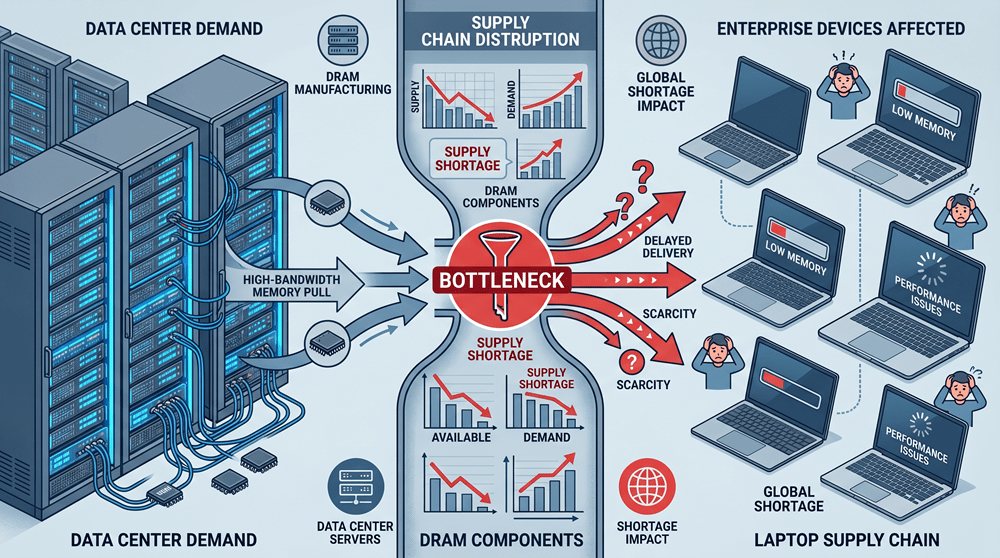
The Impact of the 2026 Memory Shortage Bottleneck
However, this necessary and urgent shift toward localized Cloud 3.0 architecture is currently colliding spectacularly with a severe hardware bottleneck: the 2026 global memory shortage. Driven by hyperscalers vacuuming up High Bandwidth Memory (HBM) wafer capacity to build out massive AI training data centers, traditional DRAM production for PCs and standard edge servers has been severely curtailed and sidelined.
This supply-demand imbalance is directly and negatively impacting the deployment of localized AI infrastructure across the board. To run a highly capable small language model (SLM) locally on an AI PC, you need substantial system memory. While the initial wave of AI PCs mandated a minimum of 16GB of RAM, serious localized enterprise AI processing—where you are actually keeping proprietary corporate data off the cloud and processing it securely on-device – is pushing those baseline requirements to 32GB or even 64GB.
Just as enterprises are realizing they must run AI at the edge to secure their data and control their runaway cloud spend, standard PC memory has become incredibly scarce and prohibitively expensive. This creates a brutal economic friction point. The localized AI trend requires robust local hardware, but the memory shortage is drastically inflating the bill of materials for OEMs and stretching out procurement timelines for enterprise IT buyers who are desperately trying to refresh their fleets to handle these secure Cloud 3.0 workloads.
What Computer OEMs Must Do to Navigate This Trend
So, what are computer Original Equipment Manufacturers (OEMs) doing, and more importantly, what should they be doing to capitalize on the Cloud 3.0 trend while navigating the memory crisis?
First, top-tier OEMs must aggressively alter their supply chain and component allocation strategies. Passive forecasting based on historical PC refresh cycles is a recipe for failure in the 2026 landscape. They need to lock in long-term memory allocation contracts immediately to ensure they can consistently deliver high-RAM AI PCs without completely destroying their own profit margins. The demand for localized memory is not a spike; it is the new baseline.
Second, they need to fundamentally rethink local device architectures and form factors. I attended a Lenovo Tech World event on the evening of January 6, 2026, and a major underlying theme was optimizing local hardware for these specific new AI workloads. OEMs must work hand-in-glove with silicon partners to heavily optimize their hardware so that local AI models lean more heavily on the Neural Processing Unit (NPU) and less on pure brute-force RAM. We are also seeing a shift in how endpoints are conceptualized. Look at Motorola’s Project Maxwell, which correctly targets the AI endpoint as a wearable companion concept rather than a traditional desktop robot, proving that localized AI will take incredibly diverse hardware forms that OEMs must support.
Furthermore, OEMs need to heavily emphasize localized security as a key selling point of this hardware. When I attended the HP Security Summit in December 2025, receiving briefings on evolving enterprise digital threats and session cookie hijacking vulnerabilities, it was abundantly clear that as AI moves to the edge, the attack surface expands dramatically. Hardware-enforced protection, such as HP’s Wolf Security, is a prime example of the necessary approach. All OEMs must integrate hardware-level telemetry to detect when localized AI agents are compromised. OEMs must sell not just a “fast AI PC,” but a sovereign, secure local AI node that acts as an impenetrable fortress for enterprise data.
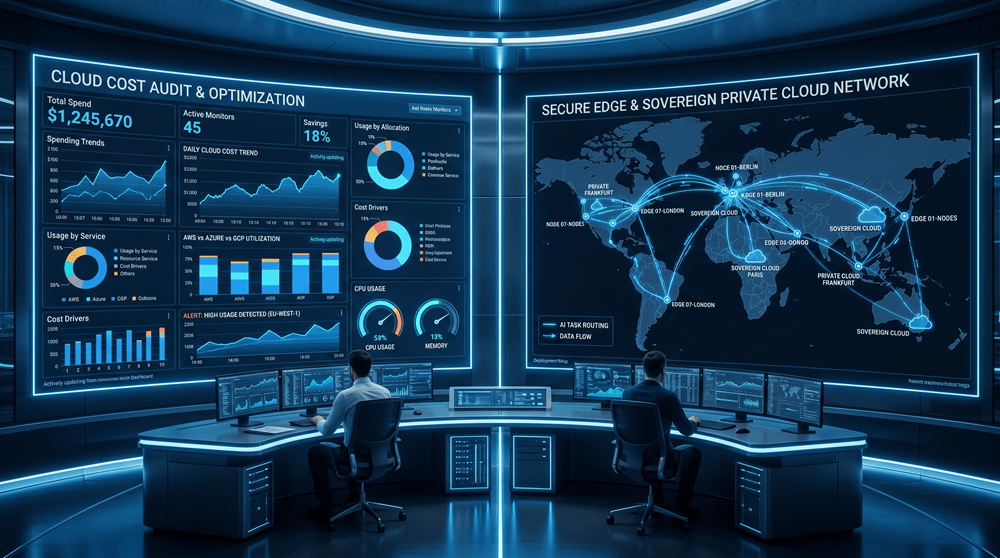
A Blueprint for Technology Buyers: Immediate and Long-Term Actions
For technology buyers and enterprise IT leaders, the shift to localized AI amid a severe memory shortage requires a complete recalibration of purchasing and deployment strategies.
Immediately, buyers must conduct a ruthless audit of their public cloud AI expenditures and their current hardware fleets. Identify which specific cloud workloads are driving consumption costs through the roof and tag them for repatriation to private or hybrid edge environments. Simultaneously, IT procurement must abandon “just-in-time” purchasing for end-user hardware. With memory lead times stretching, buyers need to submit hard purchase orders to secure allocations for 32GB+ AI PCs today for the new hires and refreshes they will need six to nine months from now. Furthermore, buyers should utilize advanced device analytics to identify exactly which employees actually require massive local memory for AI workloads, strategically right-sizing their deployments rather than blanketing the whole company with needlessly expensive hardware.
Over time, technology leaders must architect a comprehensive Cloud 3.0 infrastructure. This means implementing intelligent IT operations that dynamically and automatically route AI tasks based on cost, latency, and data sensitivity. Trivial, non-sensitive queries can and should still utilize public cloud APIs. But highly sensitive, proprietary analysis must be systematically forced onto sovereign private clouds or run entirely locally on the user’s NPU-equipped hardware. Buyers must shift their evaluation metrics from the outdated “cloud-first” mantra to “right-workload, right-location,” building a durable foundation that treats the end-user device, the edge server, and the private cloud as a single, highly governed computing continuum.
The Companies and Technologies Uniquely Benefiting
Whenever there is a massive architectural paradigm shift, significant market power and wealth are generated by those positioned correctly in the current cycle. The companies uniquely positioned to benefit from this localized AI trend are those providing the specialized silicon, the edge infrastructure, and the vital orchestration layers.
Silicon vendors are in an incredibly strong position, provided they can secure the necessary standard memory pairings for their chips. As enterprise buyers realize they need massive NPU performance to run sovereign AI locally, the upgrade supercycle for client PCs will accelerate rapidly. Having closely watched the development of hardware like AMD’s Ryzen AI processors, it is clear that their focus on providing high-performance, low-power processing directly at the point of data creation perfectly aligns with the Cloud 3.0 movement. Likewise, observing Intel’s roadmap execution under current CEO Lip-Bu Tan, their strategy is clearly shifting to capture this exact edge-inferencing demand.
Furthermore, my time at the MediaTek analyst conference in March 2026 underscored how crucial global computing and edge processing infrastructure roadmaps are becoming. The organizations that successfully design and deploy the localized edge architectures will dominate the next decade of enterprise computing, as the center of gravity shifts away from the hyperscalers and back toward the enterprise edge.
Additionally, software companies specializing in hybrid cloud orchestration, secure containerization, and private cloud management will see explosive growth. As enterprises pull back from pure public cloud dependency, the management platforms that seamlessly govern AI workloads across a sovereign private cloud and thousands of localized AI PCs will become the most valuable software assets in the entire enterprise IT stack.
Wrapping Up
The era of defaulting to the massive public cloud for all enterprise technology needs is officially over. Driven by prohibitive, unpredictable costs, crippling latency barriers, and the strict sovereignty demands of scaled artificial intelligence, Cloud 3.0 represents a necessary and permanent pivot toward hybrid, private, and intensely localized computing architectures. While the current global memory shortage presents a formidable, expensive hurdle to equipping the edge with the necessary hardware, the economic and security imperatives of localized AI are simply too powerful to ignore.
To survive and thrive in this new landscape, computer OEMs must innovate around memory constraints while aggressively locking down their supply chains, and technology buyers must immediately transition to workload-specific, localized architectures. Ultimately, the future of enterprise AI isn’t just floating up in a centralized public cloud; it is happening right here, firmly on the desk, securely in the local data center, and intelligently at the edge.

As President and Principal Analyst of the Enderle Group, Rob provides regional and global companies with guidance in how to create credible dialogue with the market, target customer needs, create new business opportunities, anticipate technology changes, select vendors and products, and practice zero dollar marketing. For over 20 years Rob has worked for and with companies like Microsoft, HP, IBM, Dell, Toshiba, Gateway, Sony, USAA, Texas Instruments, AMD, Intel, Credit Suisse First Boston, ROLM, and Siemens.